


Diamonds in jewelry
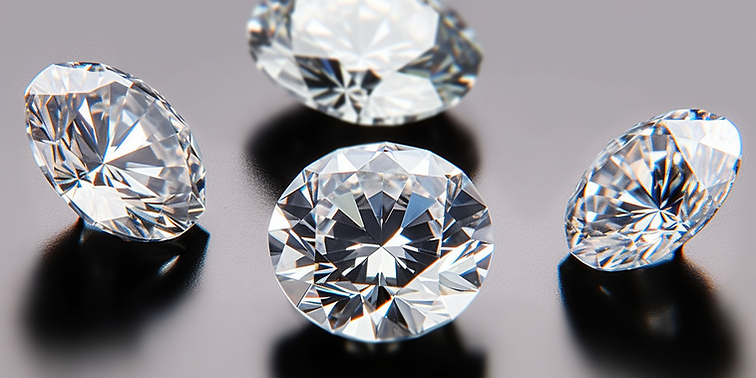
The diamond is the quintessential gemstone in the world of jewelry. It has always fascinated and adorned some of the most beautiful jewels throughout history and in the collections of major jewelry houses.
Diamonds in jewelry
It is a mineral with a very high refractive index—in fact, the highest of any crystal.
This unique characteristic allows light to travel through the stone with great ease, giving it incomparable brilliance.
Beyond this characteristic, the diamond is also renowned for its quality. What defines this quality? That is what we will look at now.
DIAMOND QUALITY: THE ESSENTIAL "4 Cs"
To determine a diamond's quality, the "4 Cs" method—developed by the Gemological Institute of America (GIA) in 1931—is used.
Did you know?
The GIA is a leading authority in the diamond industry. Based in New York, it was the world's first gemological authority. Today, it certifies the vast majority of certified diamonds in circulation.
In addition to the GIA, other well-known and prestigious certification bodies include the HRD Antwerp (Hoge Raad voor Diamant) and the IGI (International Gemological Institute).
What do these 4 Cs stand for?
1. The first C is for Carat
This refers to the measurement of the stone's weight.
This first C—carat—is particularly important, as it is a major factor in determining the price. Diamond pricing rises exponentially with weight; therefore, the higher the carat weight, the higher the price.
Note: A diamond's price is not directly proportional to its weight. For example, a 1.5-carat diamond weighs three times as much as a 0.5-carat diamond, yet its price can be 5 to 7 times higher.
In practical terms, a difference—even a tiny one—of 0.2 or 0.3 carats between two stones can significantly increase the price of a diamond piece of jewelry!
Isn’t the term "carat" also used for the quality of precious metals? Yes, that’s true, but it means something different; the two shouldn't be confused!
For a stone, the term "carat" refers to a measurement of its mass or weight, where 1 carat equals 0.20 grams.
For a metal, the carat is a unit of measurement for the purity of precious metals like gold. It is the term used to describe the metal's quality—for instance, 18-karat gold.
2. The second C stands for Color
The less color a diamond has—meaning the closer it is to pure white—the higher its quality.
The diamond industry uses a color scale to grade diamonds by quality. The scale ranges from D to Z. Here are a few examples:
-
D corresponds to "Exceptional White +" (the purest white for a diamond).
-
E corresponds to "Exceptional White."
-
G corresponds to "Extra White +."
-
H corresponds to "Neutral White."
-
...
-
M through Z correspond to tinted or pale yellow shades.
This color assessment corresponds to the first letter in the famous three-letter codes used to define diamonds, such as GVS, HSI, or DIF.
Note: High-end jewelry houses use only stones graded between D and H to ensure a luminous color and transparency in every stone.
We offer our clients only the highest color grades available—specifically, D through G.
3. The third C stands for Cut
A diamond's cut refers to its faceting—literally, the shaping of its facets.
This is of paramount importance to the stone's ultimate beauty, as the faceting is what reveals its brilliance.
In its natural state, a diamond is known as "rough"—often an opaque, misshapen mass. A perfectly executed cut transforms a rough diamond into a dazzling stone by allowing light to diffuse easily through it, thereby fully utilizing its potential for high light refraction.
Conversely, a poor cut will make the stone look dull, regardless of its inherent purity.
Note: While this point is essential for diamonds, it applies equally to all other gemstones!
How is a diamond's cut graded?
A diamond's cut is measured by a "cut grade," ranging from Excellent and Very Good to Good, Fair, or Poor.
We guarantee a selection consisting exclusively of diamonds with an "Excellent" or "Very Good" cut—the highest grades possible.
Be aware that "Good" or even "Fair" cuts prevent the diamond from fully displaying its brilliance!
4. The fourth C stands for Clarity
Clarity refers to the presence of inclusions within the stone. The fewer inclusions a diamond has, the higher its clarity grade.
What is an inclusion? An inclusion is a foreign mineral or imperfection that became trapped inside the stone during its formation. This process is completely natural for a gemstone; in fact, it serves as proof that the stone is not a lab-grown synthetic.
Like color, clarity is measured on a scale ranging from FL to P2. Here are a few examples:
-
FL (Flawless): No internal or external flaws visible under 10x magnification.
-
IF (Internally Flawless): No inclusions visible under 10x magnification.
-
VS1 and VS2 (Very Slightly Included): Inclusions that are difficult to see under 10x magnification.
-
SI1 and SI2 (Slightly Included): Inclusions visible under 10x magnification but invisible to the naked eye.
-
...
-
P2: Inclusions are visible to the naked eye.
This clarity assessment corresponds to the last two letters in a diamond's quality grade—such as GVS or HSI.
The 4 Cs therefore stand for Color, Cut (facet quality), Clarity, and Carat (weight)—all the characteristics needed to define a diamond's quality.
Consequently, every diamond comes with a certificate of authenticity detailing the 4 Cs we have just discussed!
Do you own a diamond without a certificate or with an old report? We can re-evaluate its quality based on current standards. Discover our diamond valuation service in Nice.
All our diamonds over 0.3 carats come with a certificate.
Issued by the GIA (Gemological Institute of America) or the HRD in Antwerp, this certificate acts like a passport—a unique identity document for each stone.
Why are these certificates so important?
First, they guarantee that the diamond's quality has been assessed impartially by independent international bodies, leaving no room for doubt regarding their objectivity.
These certificates are also important because they ensure the traceability of the stones and support ethical commitments.
Ethics are a priority for us—as evidenced by our 100% French manufacturing—so we source our diamonds from suppliers who strictly adhere to the Kimberley Process, ensuring that none of our stones originate from conflict zones.
Finally, our diamond suppliers all hold RJC (Responsible Jewellery Council) certification—a highly regulated standard that guarantees ethical and responsible mining practices.


